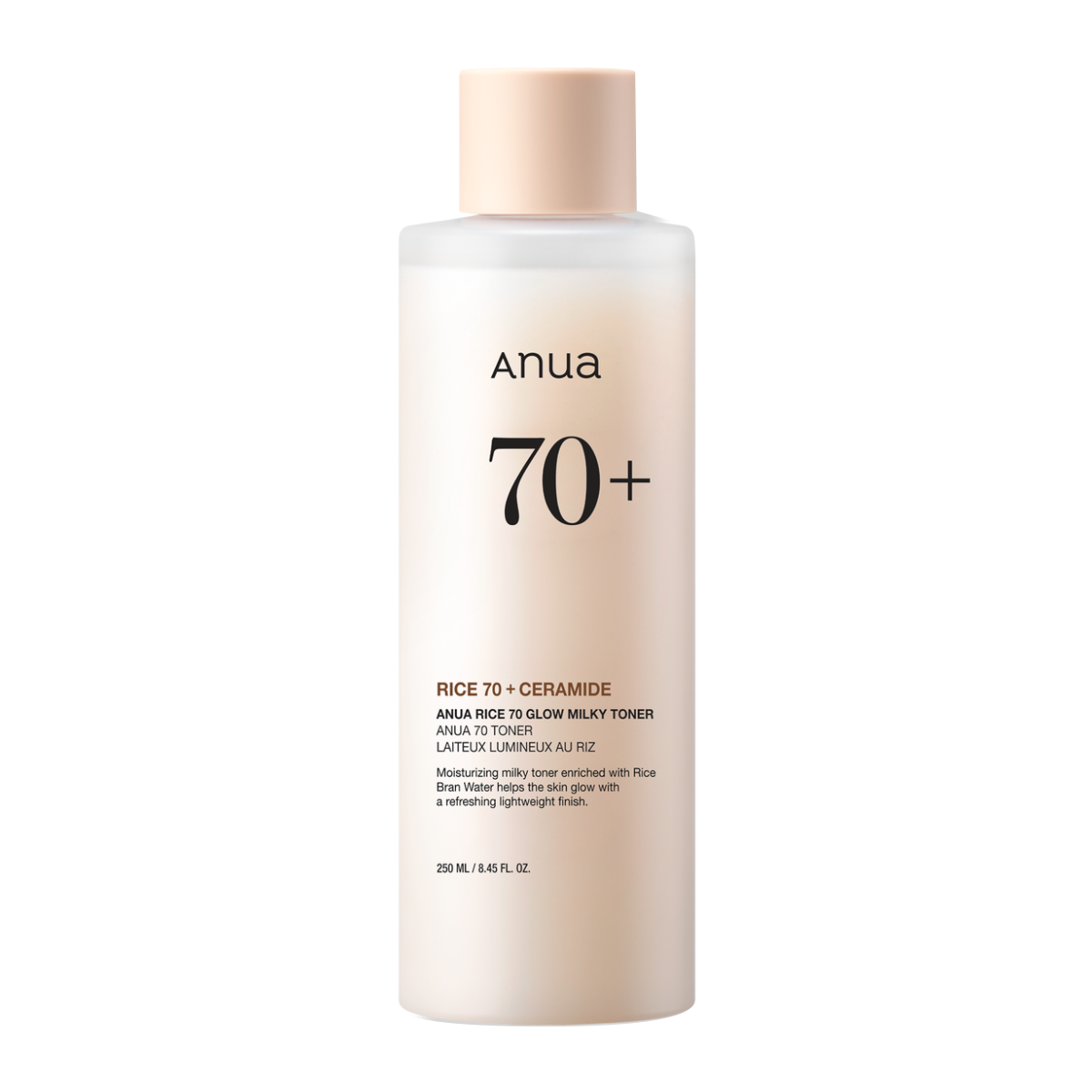
A 250 mL milky toner with rice bran water, niacinamide, panthenol and ceramides. It is distinct from Anua’s 150 mL Rice 70 Intensive Moisturizing Milk, a separate moisturizer.
After cleansing · pat with cotton or fingertips · AM/PM
Consider this if you want a toner step with a milky rather than water-clear format. Anua’s U.S. product page states 71% rice bran water and separately lists niacinamide, panthenol and ceramides; the product name “Rice 70” is not a precise statement of the rice-bran-water percentage.
Based on brand information and published sources, not a hands-on review.
01 / TEXTURE
Texture and format
Brand description
Anua describes it as a lightweight milky toner.
03 / YOUR ROUTINE
How to use it in your routine
Official directions
After cleansing, apply with a cotton pad or fingertips and pat over the face. Anua says it can be used morning and night. Use moisturizer afterward if your routine calls for it.
Anua reports 71% rice bran water and 3,753 ppm rice extract as separate formula details. Its study figures are brand-reported; the product page does not include the sample size or full methods.
The Amazon US listing is Rice 70 Glow Milky Toner in 250 mL / 8.45 fl oz. Anua sells Rice 70 Intensive Moisturizing Milk separately in a 150 mL package and identifies it as a moisturizer. The similar names refer to different products and routine steps, so check the full product name and size when ordering.
What does “Rice 70” mean on the label?
Anua’s U.S. page states 71% rice bran water and 3,753 ppm rice extract; those are separate ingredient claims. The name “Rice 70” is not itself a complete ingredient declaration. The formula also lists niacinamide, panthenol, hyaluronic-acid forms, ceramides NP, AP and EOP, cholesterol and phytosphingosine.
How does Anua say to apply it?
After cleansing, apply with a cotton pad or your fingertips and pat over the face. Anua says it can be used morning and night. The product page does not require a particular number of layers or say that the toner replaces moisturizer.
What does the U.S. ingredient list say?
Ulta’s U.S. listing for the matching 8.45 oz product spells the ingredients as “Dipropylene Glycol,” “Diphenyl Dimethicone” and “Sodium Lauroyl Lactylate.” Anua’s product page displays spacing and spelling irregularities in these same names. The complete list below follows Ulta’s listing; check the package label if a specific ingredient is important to you.
What do the study numbers mean?
Anua reports temporary moisture after one use and a 12.9% improvement in excess-sebum balance after four weeks. The product page does not give the sample size or full measurement method. These are brand-reported study results, not an expected outcome for everyone.
All names appear in the source list; no concentration claim made.
Official ingredient list ↗. Ingredient roles explain the formula. See the sourced product information and evidence limits below.
BRAND-REPORTED EVIDENCE
Official formula and use information
Anua reports immediate temporary moisture and four-week sebum results, including participant-reported outcomes, but the product page does not state the sample size or full measurement protocol. These brand statements are not guaranteed personal outcomes.
Is this the same product as Rice 70 Intensive Moisturizing Milk?
No. The toner is a 250 mL toner; the existing Intensive Moisturizing Milk is a separate 150 mL moisturizer. The names are similar, so check the full name and package.
Anua Rice 70 Milky Toner or TIRTIR Milk Skin Toner?
Both are milky toner steps. Anua’s 250 mL formula lists rice bran water, niacinamide, panthenol and several ceramides; the regular TIRTIR Milk Skin Toner here is 150 mL and has its own ingredient list. Compare formula, bottle size and application directions; this is not a measured performance ranking.
Arrange the skincare products you have saved in My routine. Opening the tool does not add a product or change your order.
Your notes and saved routine stay in this browser. They are private records, not public reviews or a test of a product’s effects.
Products with overlapping ingredient lists
Calculations use complete ingredient lists for the stated market and product version. Listed names do not establish concentrations, equivalent effects or allergy suitability.
Explore products in the same use group with overlapping ingredient lists, then compare their texture, directions and ingredient differences.
How are candidates selected?
Candidates share the page’s language, market context and use group and have a complete ingredient list available. Names are normalized for spacing and reviewed synonyms; duplicate names count once.
The default order divides shared names by all distinct names across both lists: 10 shared names out of 20 distinct names gives 10 ÷ 20. You can instead order by the number of shared names. Up to five candidates are shown.
Ingredient overlap does not establish equivalent effects or a cheaper substitute. Concentrations, ingredient order, finished-product tests and feel are not part of this calculation. Missing lists are not treated as missing ingredients.