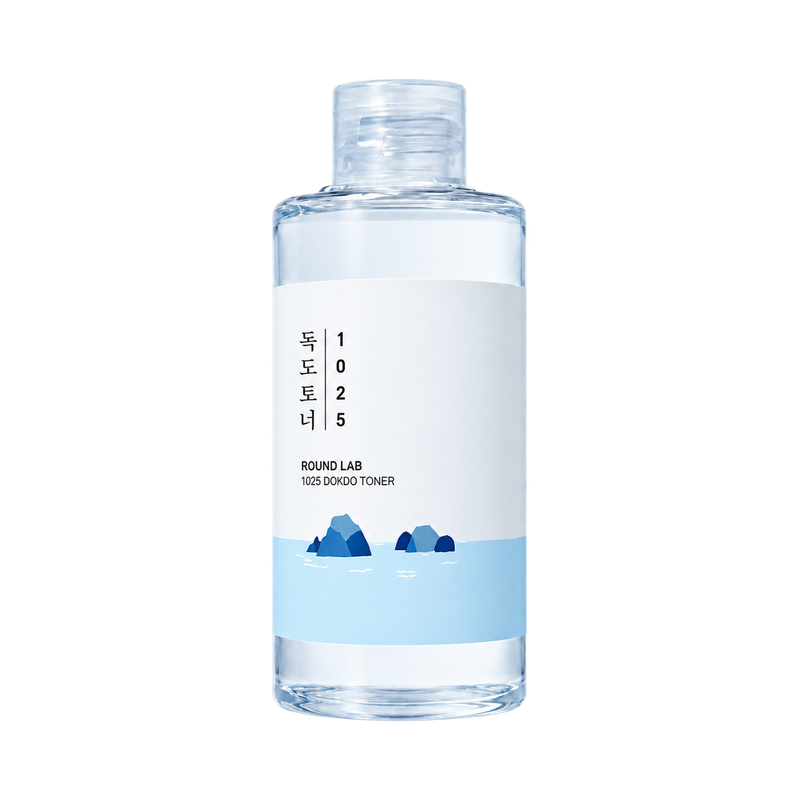
Watery, viscous-looking and milky toners in photographs
Look at flow and color or opacity separately. These brand photographs show examples from the named Korean-market products.
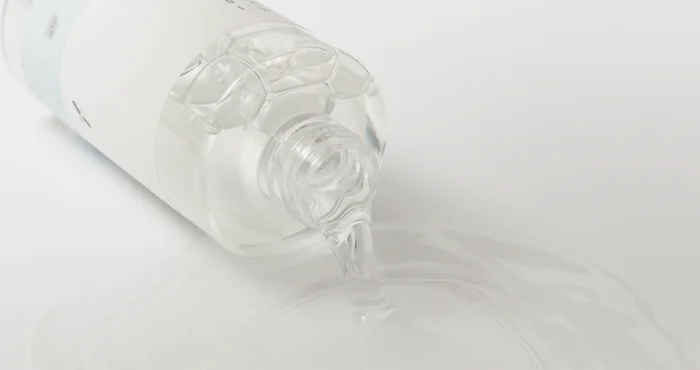
WATERY
Watery toner
A clear liquid pours from the bottle and spreads in a thin layer.
Watery describes how a liquid flows. Transparency is a separate visual property: a clear toner can still contain humectants. This is an appearance example, not a measurement of hydration.
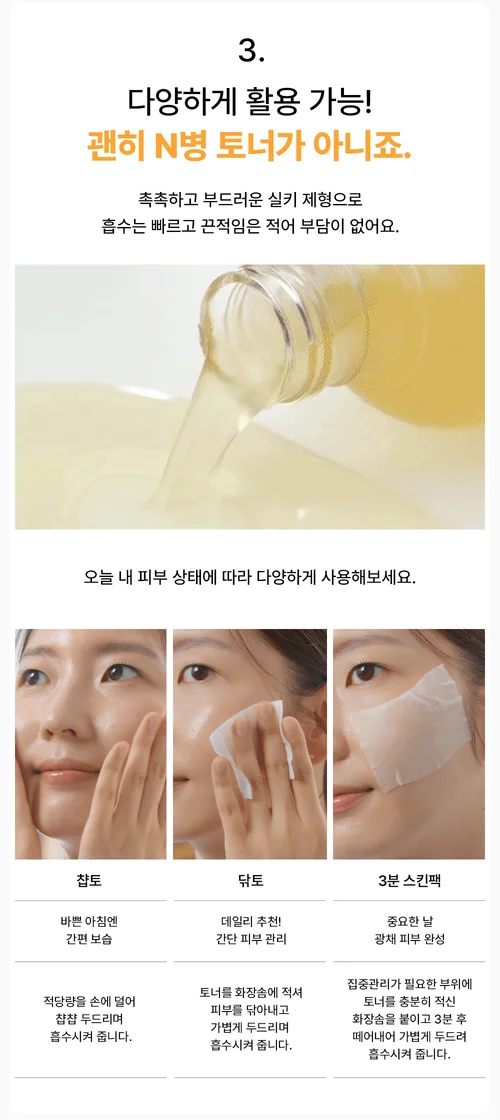
CUSHIONED
Toner with a thicker-looking texture
The yellow-toned liquid forms a smooth, continuous stream. COSRX describes a silky texture.
A flowing strand can help you see the product body, but sticky and viscous do not mean the same thing. Because the products were filmed under different conditions, these images cannot establish which toner is more viscous.

MILKY
Milky toner
The liquid has an opaque, milky appearance.
Milky describes color and opacity. A milky formula can also flow easily, so milky and watery are not opposite ends of one scale. Read the formula and directions of the exact product.
Photographs and pouring scenes from the named Korean brand pages. These are appearance examples, not comparative viscosity or hydration tests. Check the version sold in your market.
Clear can be viscous, and milky can be fluid. A thicker appearance does not establish better moisturizing performance. Read ingredient roles and finished-product evidence alongside the photograph.
Does a milky toner replace moisturizer?
“Milky” describes an opaque appearance. It does not specify how much oil the formula contains, how thick it is, or whether it supplies the moisturizing step your routine needs.
| What you are comparing | Read on the exact product |
|---|---|
| Clear or milky | The actual liquid’s color and opacity |
| Watery or more viscous | The pouring or spreading scene; photographs are not a viscosity measurement |
| Toner, essence or lotion | Directions, whether it stays on skin, and where it fits in the routine |
| Whether to add a cream | The role of your existing moisturizer and how the complete routine feels |
YOUR SITUATION → YOUR CHOICE
Liquid toner or toner pads: choose by how you will use them
Both formats sit in the same place in a routine — after cleansing, before a serum or moisturizer. The main differences are how you apply each format, what its directions say, and whether you are comfortable with the wiping step.
| What to compare | Liquid toner | Toner pad |
|---|---|---|
| How it goes on | Poured or sprayed on; spread with hands or a cotton pad | A pre-soaked pad, placed on an area or wiped across it |
| Directions to check | Amount and order on the product page | Leave-on time and wiping directions on the product’s official page — Anua’s official pad directions say 10–20 minutes in place, then a gentle wipe |
| If your skin dislikes wiping | Applied with hands, no wiping step is required | The pad format adds friction by design; weigh that before choosing it |
| What it replaces | One leave-on hydration step after cleansing | The same step — not an extra layer on top of a liquid toner |
What a toner actually does in a routine
Toners vary by formula and directions. The hydration-focused Korean toners discussed here are used after cleansing and before a serum or moisturizer. They do not replace a cleanser when you need to wash something off, and they are not required steps or weaker serums. Check the exact product’s instructions and ask what it adds to the routine you already have.
Liquid toner or toner pads: same step, different format
A liquid toner is poured or sprayed on and spread with your hands or a cotton pad. A toner pad is a pad pre-soaked in a toner-like formula. Anua’s official directions for its pads say to place them on an area for 10–20 minutes, then wipe gently — those are that brand’s directions for those products, not a rule for every pad. Because a pad adds wiping, the format itself is part of the choice: if your skin dislikes friction, a liquid applied with your hands avoids that step. Either way, one toner-format step is enough; a pad does not need a liquid toner underneath it.
Choosing a toner when skin is sensitive or acne-prone
Start with the directions and the ingredient list, not the word “calming” on the front. For sensitive-feeling skin, the pad’s wiping step and leave-on time are the variables to weigh, and a fragrance-free liquid toner is the simpler format to compare. For acne-prone skin, a toner is a cosmetic step, not a treatment. Read any non-comedogenic statement as a brand claim, and do not stack a pad, a liquid toner and an exfoliating step that all do similar work. Add one new product at a time so you can tell what changed.
What about a “rice toner”?
A “rice toner” is not a different kind of step. It is a toner whose formula highlights rice-derived ingredients, such as rice extract or rice bran water — the name tells you the highlighted ingredient, not a different job in the routine. If you are comparing one, check the same things as with any toner: the official directions, the full ingredient list (INCI), the texture, and which market version of the product is being sold, because formulas and names can differ by country. Any effect named on the front of the bottle is that brand’s claim for that product, not a property of rice toners as a group.
Do you need a toner, an essence and a serum?
Not by default. These are neighbouring leave-on steps, and their jobs often overlap — light hydration, one highlighted ingredient, a texture you enjoy. Before adding a toner next to an essence or serum you already use, name what would change: an ingredient you want, a texture you prefer, or a step you are replacing. If nothing changes, the toner is a preference, not a gap in your routine.
A few useful answers
Can I skip toner entirely?
Yes. Cleansing, moisturizing and daytime sun protection do not depend on a toner — a routine built on those steps is complete without one.
Can a toner pad replace my liquid toner?
Yes — they are two formats for the same step. Use one or the other, and follow that product’s directions, including any leave-on time before wiping.
Is a toner the same as an exfoliant?
Not automatically. Some toners are exfoliating formulas and say so in their description; many are hydration steps. Read the product’s own description and directions instead of assuming from the word “toner.”
Can I use a milky toner if my skin is oily?
A milky appearance alone is not a reason to rule a toner out. It describes an opaque color, not how heavy the formula will feel or whether it will suit your skin.
Check whether you want an extra leave-on step and follow the exact product’s directions. A toner does not automatically replace moisturizer; judge what it adds to your existing routine rather than choosing by color alone.
One US-listed example is Anua Rice 70 Glow Milky Toner (250 mL). Anua describes it as lightweight and directs application after cleansing with fingertips or a cotton pad, morning or night. That description is the brand’s, not our own wear test or a guarantee of the finish on your skin.
Anua US Rice 70 Glow Milky Toner · product and directions · checked 25 October 2026 ↗