Retinal at a glance
| Ingredient name | Retinal; retinaldehyde |
|---|---|
| Family | Vitamin A derivatives, or retinoids |
| Read on the label | Retinal in the ingredient list; the product’s own directions |
| Studied concentrations below | 0.05% and 0.1% creams in one dose-comparison trial |
Retinal, retinol and HPR are different ingredients
The short name retinal refers to retinaldehyde. A simplified skin-metabolism pathway is retinol → retinaldehyde → retinoic acid. The metabolism study used skin extracts and cultured cells as well as other models; it was not a comparison of retail products.
HPR stands for hydroxypinacolone retinoate. It is a separate retinoid derivative, not another name for retinal. When comparing a label, keep the full ingredient name rather than treating every vitamin A derivative as the same substance.
- Retinol
- Retinal / retinaldehyde
- Retinoic acid
Does 0.1% retinal equal 1% retinol?
There is no validated universal conversion between those product percentages. The molecule, complete formula and application schedule can differ, so the larger number alone does not identify the better choice.
First check what the percentage describes: retinal itself, a named complex, or an encapsulated blend. Then compare the exact product directions and the finished-product evidence. Do not turn an ingredient-conversion pathway into a ten-to-one potency claim.
| What to compare | What it tells you |
|---|---|
| Ingredient identity | Retinal, retinol and HPR are not interchangeable names. |
| Percentage wording | An ingredient percentage and a blend percentage describe different things. |
| Your routine | Check frequency, amount, moisturizer and other retinoid products already in use. |
What did the 0.05% and 0.1% cream study find?
In 2018, 40 Korean women used either 0.1% or 0.05% retinaldehyde cream twice daily for three months. Researchers assessed crow’s-feet texture, hydration and water loss.
| Measure after three months | 0.1% cream | 0.05% cream |
|---|---|---|
| Texture improvement | 13.7% | 12.6% |
| Water-loss reduction | 14.5% | 17.9% |
| Hydration increase | 10.2% | 6.0% |
There was no statistically significant difference between concentrations for these measures. Only the 0.1% group had a significant melanin-index improvement, reported as 6.5%.
This was a comparison of two active creams; the abstract does not describe a vehicle-only group. The trial schedule is not a twice-daily instruction for the product you buy.
How should a beginner start?
Use the directions for the exact formula. The AAD advises beginning with a less-intense retinoid formulation every other night, increasing gradually, and using moisturizer. Use sun protection during the day.
Look at your current routine before adding another active product. If substantial redness, inflammation or persistent irritation is already present, ask a dermatologist about a suitable approach. Irritation is not a measure of how well a product is working.
| Check | Practical starting point |
|---|---|
| Frequency | Use the exact product’s introductory schedule. |
| Amount and area | Follow its label; a booster and a whole-face cream can have different instructions. |
| Skin response | Do not increase frequency while irritation is continuing. |
| Daytime | Use sunscreen, clothing and shade for sun protection. |
What about pregnancy or breastfeeding?
Avoid retinoids during pregnancy. If you are pregnant, planning pregnancy or breastfeeding, review your skin-care products and medications with your obstetrician or dermatologist. Breastfeeding advice should account for the particular product and your circumstances.
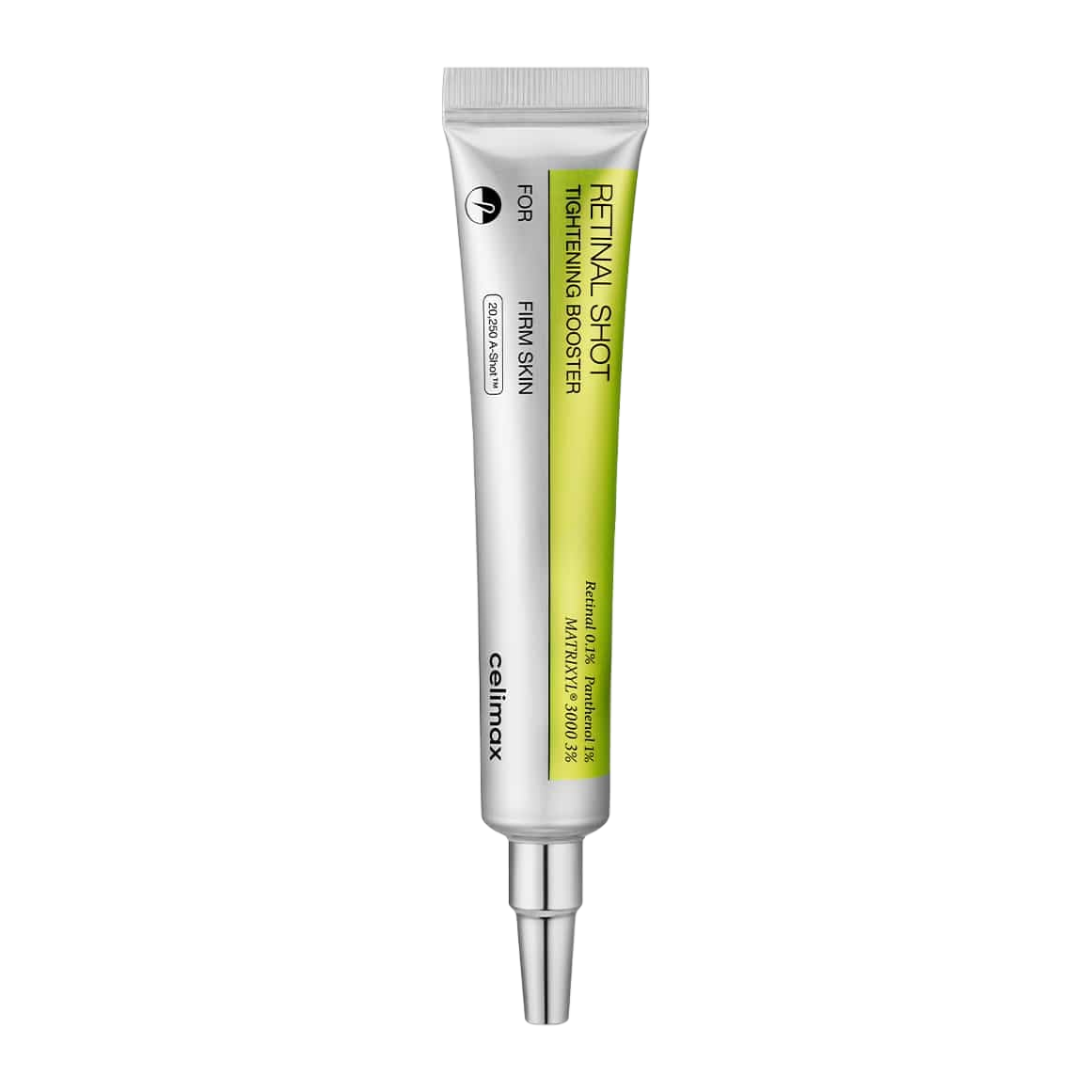
A product example: celimax Retinal Shot Booster
The US 15 mL product lists 0.1% retinal. It is a specific formula with panthenol and other ingredients, rather than a tube of retinal alone.
For new retinol or retinal users, its US page says every other night for the first two weeks. Apply a small amount to targeted areas; reduce amount and frequency if irritation occurs. It also gives an all-face application direction after adaptation.
| Brand-reported measure | Published result |
|---|---|
| Pore volume, after one use | −13.33% |
| Pore density, after one use | −12.21% |
| Forehead wrinkles, after two weeks | −28.54% |
| Nasolabial folds, after two weeks | −18.49% |
The page does not give sample size, comparator or measurement method for these figures. They are separate from the cream study above; a different formula’s results cannot be assigned to this booster.
celimax · current US product information ↗
Skin reactions and retinoids
Retinoid breakouts, irritation, and the “purge” question
“Purging” is not a reliable diagnosis. A change in bumps after starting a retinoid could reflect ordinary acne variation, a product-related breakout, irritation, or another skin condition. Timing and location alone cannot tell which one it is.
What does the evidence say about a retinoid “purge”?
“Purging” is a popular shorthand, not a clinical diagnosis with a validated checklist. A 2009 review looked for clinical-trial evidence that topical retinoids routinely make acne worse at the start and found no primary trial data supporting that belief; the data it reviewed suggested acne could improve during the first weeks. A later analysis of adapalene trial data likewise found no flare signal after the first week.
There is an important qualification: the 2025 FDA label for one prescription tretinoin gel says an apparent increase in inflammatory acne lesions may occur during its early weeks; if the medicine is tolerated, that change alone is not a reason to discontinue it. The same label separately warns that irritation can include dryness, redness, swelling, peeling, itching, blistering, burning, or stinging, and says severe local irritation may require temporarily or permanently stopping it. These statements concern that specific prescription product; they do not establish that every new breakout is a “purge,” or tell anyone to push through a rash.
The 2012 adapalene analysis cautions that trial averages do not show what happened to each participant and cannot exclude an increase in an individual. It used trial data for adapalene (alone or combined with benzoyl peroxide), not tretinoin or cosmetic retinol; the paper reports Galderma funding and that several authors were company employees or consultants. Read it as product-specific evidence with stated limitations, not proof that no individual can flare.
The evidence therefore differs by product and study design: the FDA label addresses one tretinoin microsphere gel; the older review searched broad topical-retinoid literature; the 2012 analysis assessed specific adapalene trial data. Neither timing, lesion location, nor the word “purge” can diagnose an individual change.
Yentzer et al. · review of early acne flare evidence (PubMed abstract, English) ↗
Leyden et al. · full adapalene clinical-trial lesion-count analysis (Cutis, English) ↗
How can a breakout differ from irritation?
These patterns can overlap. They are clues to describe to a clinician, not a way to diagnose yourself.
| What you notice | What it may suggest | What it cannot establish |
|---|---|---|
| New or changing acne bumps, without a broader itchy or burning rash | Acne fluctuation or a product-related breakout are both possible | It does not prove a beneficial “purge,” even if the spots appear in an acne-prone area |
| Burning, stinging, tightness, dryness, redness or scaling where the product was applied | Irritant contact dermatitis is one possibility; topical retinoids can irritate | A symptom list cannot confirm the cause or severity |
| Marked itch, swelling, blistering, a spreading rash, or a reaction beyond the application area | A stronger reaction, allergy, or another condition needs consideration | Appearance alone cannot distinguish allergy from irritation; clinical assessment may be needed |
A review of topical acne-drug reactions describes irritant contact dermatitis as commonly involving redness, burning, dryness, scaling or itching; allergic contact dermatitis is a different, less common reaction in that review. Irritation does not automatically mean allergy, but a persistent or severe reaction should not be treated as proof that the product is working.
American Academy of Dermatology · prescription and nonprescription acne medicines (English) ↗
What should I do if my skin changes?
If the reaction is mild but bothersome
Pause the new nonprescription cosmetic and note the exact product, ingredients, where you applied it, when symptoms began, and what else changed in your routine. Do not add more exfoliants or another retinoid to “push through.” Follow the product label. If you are using prescription tretinoin, contact the prescriber before changing its schedule.
If symptoms are severe, spreading, or persistent
Wash off a suspected cosmetic product gently and stop using it. Seek medical advice for a severe, worsening, persistent, painful, swollen, blistering, or spreading reaction, or if you are unsure whether this is acne or a rash. Urgent symptoms such as trouble breathing or swelling of the lips, tongue, or throat require emergency care.
AAD guidance says a skin-care reaction should be washed off and the product not reused; severe reactions that do not settle need medical attention. This is general safety information, not a diagnosis or a substitute for the instructions that came with a prescription.
American Academy of Dermatology · what to do after a skin-care reaction (English) ↗
American Academy of Dermatology · prescription and nonprescription acne medicines (English) ↗
Is tretinoin a retinol?
No. Tretinoin is all-trans retinoic acid, a retinoid. Retinol is a different vitamin A derivative that skin can convert through retinaldehyde to retinoic acid. The terms are related, but they do not name the same ingredient.
In the United States, topical tretinoin products are prescription drugs; AAD lists tretinoin among prescription acne retinoids. Cosmetic retinol products are a separate category. A percentage printed on one product cannot be converted into an equivalent percentage, strength, or expected effect for the other. The complete formula, vehicle, directions, and regulatory category differ.
If your question is about a tretinoin prescription, use its current label and ask the prescriber or pharmacist about a reaction or change. Do not substitute cosmetic retinol for a prescription, or the reverse.
FDA · Retin-A Micro prescribing information (English) ↗
American Academy of Dermatology · prescription and nonprescription acne medicines (English) ↗
American Academy of Dermatology · retinoids and retinol (English) ↗
Questions people ask about retinoid reactions
Does acne getting worse mean a retinoid is working?
No. A breakout or irritation cannot be used as proof that a product is working. The term “purging” does not identify the cause, and acne can fluctuate on its own.
Can I tell from how long it has been or where the bumps are?
No dependable time cutoff or location rule can diagnose a purge. Record the change and seek clinical advice if it is worsening, painful, spreading, or unclear.
Does irritation mean I am allergic to tretinoin?
Not necessarily. AAD notes that irritation does not typically mean medication allergy. A clinician can assess the reaction; do not label it an allergy or rule one out from appearance alone.
Sources and evidence limits
Evidence checked 28 October 2026. Early-worsening evidence includes reviews and analyses of specific clinical-trial data; it does not diagnose an individual reaction. FDA and AAD sources establish US prescription status and safety guidance, not a cosmetic equivalence or personalized treatment plan.
- Yentzer et al. · review of early acne flare evidence (PubMed abstract, English) ↗
- Leyden et al. · full adapalene clinical-trial lesion-count analysis (Cutis, English) ↗
- Foti et al. · review of irritant and allergic contact dermatitis from topical acne medicines (PubMed abstract, English) ↗
- American Academy of Dermatology · retinoids and retinol (English) ↗
- American Academy of Dermatology · prescription and nonprescription acne medicines (English) ↗
- American Academy of Dermatology · what to do after a skin-care reaction (English) ↗
- FDA · Retin-A Micro prescribing information (English) ↗
Questions when choosing a retinal product
Are retinal and retinaldehyde the same?
Yes. Retinal is the shorter name for retinaldehyde. Look for Retinal in the ingredient list.
Does fewer conversion steps mean every retinal product works faster?
No. A metabolism pathway is not a head-to-head test of finished products. Formula and application conditions also matter.
Must I start with 0.1%?
The cream study does not establish a best starting concentration for everyone. Compare the exact product’s introductory directions and your skin response.
Is this US product example the Korean formula?
The example uses the US product information. A Korean purchase should be checked against its own current packaging and directions.
Sources and research context
Research and product information checked 24 October 2026. Ingredient studies, professional guidance and manufacturer product claims are identified separately.
- Sorg et al., 1999 · retinaldehyde metabolism ↗
- Kwon et al., 2018 · 0.05% and 0.1% retinaldehyde creams ↗
- American Academy of Dermatology · retinoid guidance ↗
- American Academy of Dermatology · pregnancy skin care ↗
- celimax · current US product information ↗
- Hu et al., 2026 · hydroxypinacolone 9-cis retinoate ↗